
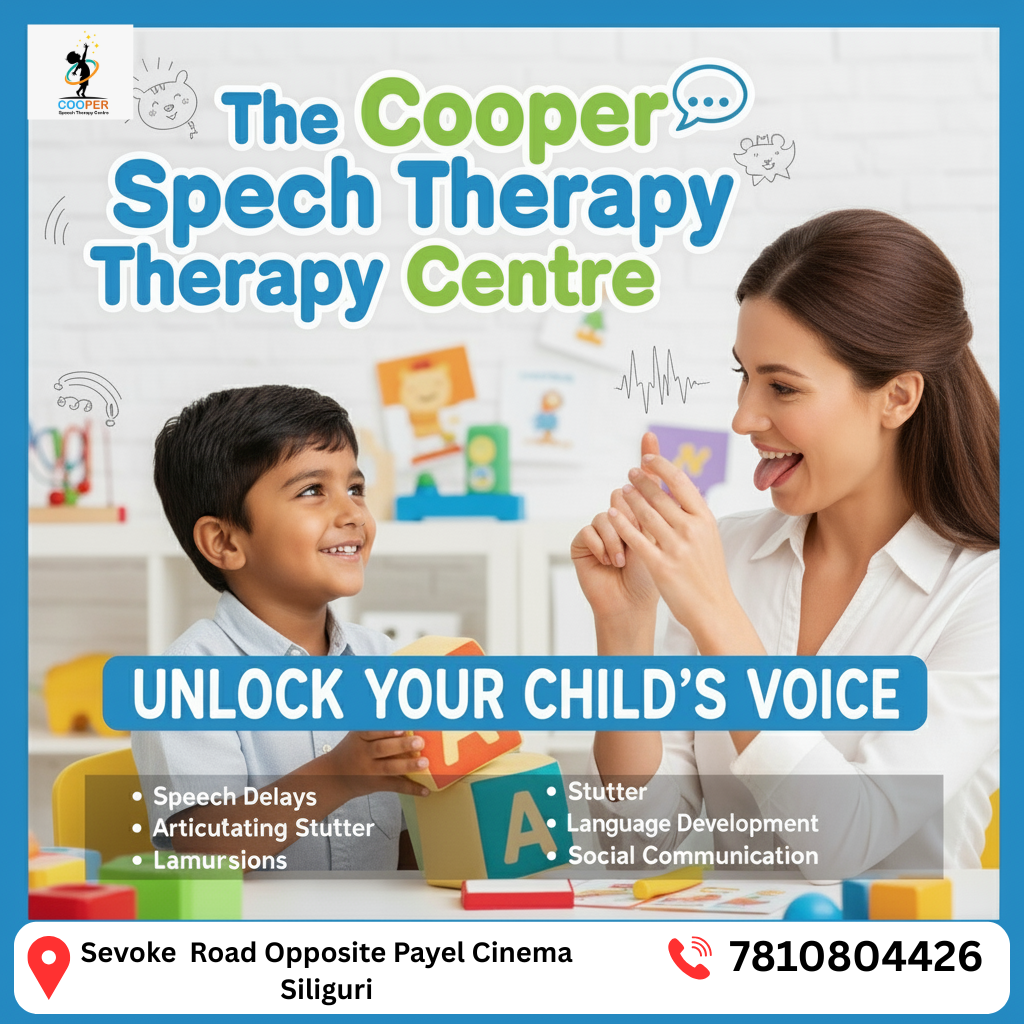
Every children deserves the ability to express their thoughts, needs, and emotions clearly. However, many children struggle with speech delays, unclear pronunciation, stuttering, or difficulty understanding language. These challenges can affect not only communication but also academic performance, social interaction, and emotional well-being.
At The Cooper Speech Therapy Centre, Siliguri, we believe that every child has a voice that deserves to be heard. Our mission is to help children overcome communication barriers and build confidence through structured, evidence-based speech and language therapy.
With a dedicated team of speech-language pathologists, child-friendly therapy methods, and a personalized approach, we support children facing speech delays, articulation issues, stuttering, language development delays, and social communication challenges.
This blog will help you understand what speech therapy is, why early intervention matters, what signs to look for, what conditions we treat, and how our centre is helping hundreds of families in Siliguri unlock their child’s voice.
Understanding Speech Therapy: What Does It Really Mean?
Speech therapy is a specialized service that helps children improve their speaking ability, language understanding, and communication skills. It involves diagnosing and treating communication disorders through structured, scientifically backed techniques.
Speech therapy at Cooper includes:
- Speech Sound Training – Helping children pronounce sounds correctly.
- Fluency Therapy – Reducing stuttering and teaching smooth speech.
- Language Development – Improving understanding, vocabulary, sentence formation, and grammar.
- Social Communication Training – Supporting children in learning conversation skills, eye contact, and social interaction.
- Voice Therapy – Teaching children how to use their voice safely and effectively.
Through a combination of play-based activities, speech exercises, flashcards, games, and interactive communication tasks, therapy becomes fun, engaging, and effective.
Why Speech Therapy Is Important
Communication is not just about talking; it’s about connecting. When a child struggles to express themselves or understand language, they may face:
- Difficulty forming friendships
- Problems performing academically
- Low confidence
- Emotional frustration
- Reduced participation in activities
Without timely help, these issues may continue into adulthood.
Early therapy helps children:
- Improve speech clarity
- Talk with confidence
- Communicate needs better
- Develop strong language skills
- Perform better in school
- Build social relationships
- Reduce frustration during communication
At Cooper Speech Therapy Centre, we focus on long-term development as well as immediate improvements.
Does My Child Need Speech Therapy? Signs Parents Should Watch For
Every child develops at their own pace, but certain signs may indicate a delay or disorder. Many parents wait too long, hoping the child will “catch up.” But early intervention gives the best results.
Common signs your child may need speech therapy:
Speech Delay
- Not speaking single words by 18 months
- Not forming sentences by age 2–3
- Using fewer words than other children their age
- Difficulty naming objects or expressing ideas
Articulation Problems (Mispronunciation)
- Saying “wabbit” instead of “rabbit”
- Leaving out sounds (“ca” instead of “cat”)
- Speech that is difficult to understand
Stuttering (Fluency Issues)
- Repeating sounds (“b-b-ball”)
- Stretching sounds (“ssssssun”)
- Blocking or getting stuck
- Visible frustration while talking
Language Development Delay
- Difficulty understanding instructions
- Poor vocabulary
- Trouble forming meaningful sentences
- Difficulty answering questions
Social Communication Problems
- Avoiding eye contact
- Difficulty taking turns in conversation
- Not engaging in play with other children
If your child shows two or more of these signs, a speech assessment is highly recommended.
What Causes Speech Delays in Children?
Speech delays can happen for many reasons. It is important to understand that a delay does not mean a child is not intelligent. Many extremely smart children simply need support developing communication skills.
Possible causes include:
- Developmental delays
- Hearing issues
- Tongue or oral structural concerns
- Autism spectrum indicators
- Environmental factors (less speaking exposure)
- Neurological conditions
- Genetic influences
Regardless of the cause, early therapy significantly improves outcomes.
How Speech Therapy Works at Cooper Speech Therapy Centre, Siliguri
We believe in a structured yet joyful method, making therapy both effective and enjoyable.
1. Initial Assessment
Our speech pathologists conduct a comprehensive evaluation that includes:
- Speech sample analysis
- Language understanding tests
- Communication behavior observation
- Parent interview and developmental history
- Standardized assessment tools
This helps us identify the exact difficulty and create the right therapy plan.
2. Personalized Therapy Plan
Every child gets a customized therapy plan based on their needs.
This plan includes:
- Weekly goals
- Targeted sound practice
- Language development exercises
- Stuttering control exercises
- Parental guidance tasks
Personalized therapy ensures faster and more effective results.
3. Play-Based Learning
Children learn best when they enjoy the process.
We use:
- Toys
- Flashcards
- Games
- Puzzles
- Storybooks
- Role-play
- Visual charts
This ensures the child is fully engaged while building communication skills.
4. Parent Training
Parents play a vital role. We guide you on how to:
- Talk to your child effectively
- Encourage speech at home
- Practice articulation exercises
- Develop language skills through daily routines
- Reduce pressure and build confidence
Parents who follow home strategies notice faster results.
5. Regular Progress Monitoring
We review your child’s progress every month to ensure therapy stays on track.
Adjustments are made whenever needed to maximize improvement.
Conditions We Treat at Cooper Speech Therapy Centre
Our experienced team provides therapy for:
✔ Speech Delays
Helping children develop age-appropriate vocabulary and sentence formation.
✔ Stuttering / Stammering
Improving fluency using scientifically proven techniques.
✔ Articulation & Pronunciation Problems
Correcting mispronounced sounds and improving clarity.
✔ Language Development Delays
Building understanding, grammar, vocabulary, and expression.
✔ Social Communication Difficulties
Helping children improve eye contact, play skills, turn-taking, and conversation skills.
✔ Communication Disorders in Autism
Providing structured communication therapy for children with ASD indicators.
✔ Voice Disorders
Training children to use their voice safely and comfortably.
Why Choose Cooper Speech Therapy Centre, Siliguri?
Choosing the right therapy centre can change your child’s future. We ensure a warm, caring, and highly professional environment.
What makes us different?
✔ Certified Speech-Language Pathologists
Highly trained professionals with years of experience.
✔ Child-Friendly Environment
Kids learn better when they feel safe and happy.
✔ One-on-One Personalized Sessions
Ensures maximum attention and faster progress.
✔ Evidence-Based Techniques
We follow international therapy standards for best results.
✔ Affordable Therapy Packages
Quality therapy at reasonable prices.
✔ Convenient Location
Located at Sevoke Road, Opposite Payel Cinema, Siliguri — easy to reach.
✔ Quick Results With Consistency
Many parents notice improvement within weeks.
How Speech Therapy Helps Children in the Long Run
Speech therapy doesn’t just fix speech; it builds a child’s entire personality.
Long-term benefits include:
- Strong academic performance
- Better social confidence
- Improved emotional expression
- Clear and confident speech
- Strong vocabulary
- Better pronunciation and fluency
- Enhanced communication in daily life
Children who receive early therapy often grow into confident, expressive adults.
Parent Tips to Improve Your Child’s Speech at Home
Parents can accelerate progress with simple activities:
1. Talk regularly with your child
Describe everything you are doing: cooking, cleaning, walking, etc.
2. Read storybooks every day
Books improve vocabulary and creativity.
3. Encourage conversations
Ask open-ended questions like “What happened today?”
4. Give choices
Example: “Do you want a red cup or blue cup?”
This encourages expressive language.
5. Reduce screen time
Screens limit real communication, especially for toddlers.
6. Praise small improvements
Speech delay is not your fault, and it is not your child’s fault.
What matters is taking the right step at the right time.
Early therapy can change your child’s entire life trajectory.
At The Cooper Speech Therapy Centre, Siliguri, we are here to support you every step of the way. Together, we can help your child unlock their true potential and communicate with confidence.
Visit Us Today
📍 Sevoke Road, Opposite Payel Cinema, Siliguri
📞 7810804426
-
How long is each therapy session?
Sessions are generally 30–45 minutes depending on the child’s attention span and therapy needs.
-
Do you offer one-on-one therapy?
Yes. All sessions at Cooper Speech Therapy Centre are one-on-one, ensuring focused and personalized treatment.
-
Are parents involved in the therapy?
Absolutely. Parents receive home-based strategies so that improvement continues outside sessions. Parent involvement increases progress significantly.
-
Do you offer online speech therapy?
Yes. Online sessions are available for children who cannot attend in person.
-
What is the location and contact number?
📍 Sevoke Road, Opposite Payel Cinema, Siliguri
📞 7810804426 -
What is the fee for speech therapy?
Fees depend on the type of delay and therapy plan. You can call us for detailed pricing information.
-
Is speech delay normal?
Some children develop slowly, but continuous delay or difficulty should not be ignored. Early intervention is the key to best results.
-
Can speech delay affect school performance?
Yes. Speech and language are essential for reading, writing, and learning. Therapy strengthens school readiness and academic development.